2026 Tours


2027 Tours
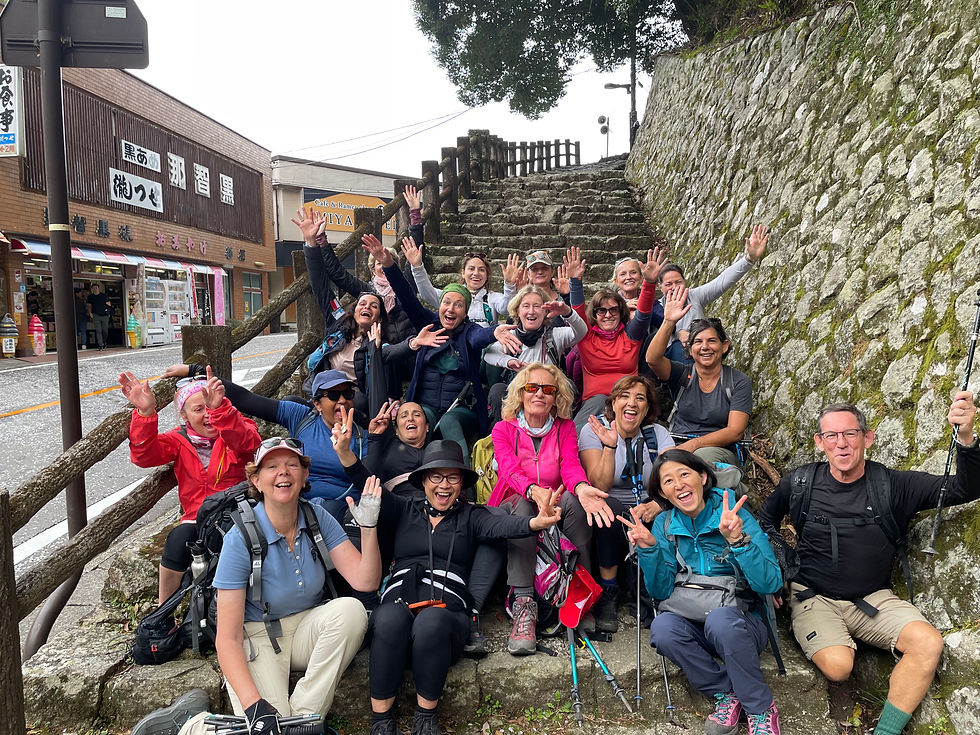




Is This the Right Way to Walk the Kumano Kodo?
Walking the Kumano Kodo as a complete pilgrimage means intentionally visiting all three sacred Kumano shrines, known collectively as the Kumano Sanzan. Traditionally, the journey was understood as a progression with a beginning, middle, and completion, rather than a single section walked in isolation. By walking with this full pilgrimage perspective, the experience becomes more than a series of trails. It becomes a coherent journey of reflection, continuity, and meaning that honours how the Kumano Kodo has been walked for centuries.
Why Fully Guided Is Not “Less Adventurous”.
Just More Intentional.
Walking the Kumano Kodo fully guided is not about walking less.
It is about carrying less, mentally, emotionally, and logistically, so you can be fully present for the journey itself.
When everything is self-managed, much of your energy is spent navigating, problem-solving, checking details, and making constant decisions. While that suits some travellers, it often pulls attention away from the deeper experience this sacred route offers.
A fully guided pilgrimage allows you to step out of planning mode and into presence.

Presence instead of planning
Each day unfolds with care and intention. Accommodation, meals, transport, pacing, and daily logistics are handled for you, allowing your focus to remain on the walk, the landscape, and your own reflections.
Trust instead of uncertainty
You are supported by experienced guidance and local knowledge, removing the low-level stress that can accompany route decisions, timing, language barriers, or unexpected changes. If something shifts, you are not navigating it alone.
Depth instead of distraction
With fewer decisions to make and fewer details to manage, space opens up — for silence, for conversation, for noticing the small moments that often become the most meaningful. This is where the Kumano Kodo reveals itself not just as a trail, but as a pilgrimage.
Many people discover that being fully guided does not diminish the challenge or the sense of achievement. Instead, it changes the quality of the experience, allowing the walk to meet them at a deeper level.
If you are curious about how this compares to walking independently, and why some travellers intentionally choose a fully guided approach, we explore this in more detail in our Travel Notes.
What You Can Expect Day to Day
Walking the Kumano Kodo fully guided is not about pushing through each day. It is about being gently carried through it.
Each morning, you are met with clarity rather than questions. The pace is considered. Rest is built in. You know where you are going, where you will sleep, and that you are supported every step of the way.
Some days invite quiet reflection by experiencing forest bathing. Others open space for shared conversation. There is no pressure to perform, keep up, or prove anything. You walk your own rhythm, knowing guidance is always close when you need it.
When energy rises, the trail meets you there.
When energy dips, you are supported, practically and humanly.
This way of walking creates room to notice more: the forest, the shrines, your breath, your thoughts. What unfolds each day is not just a route, but a lived experience, steady, grounded, and deeply present.
See How the Day Unfolds
Kumano Kodo Fully Guided 6-Day Tour Itinerary
This fully guided journey follows carefully chosen sections of the Kumano Kodo, designed to honour the spirit of the pilgrimage rather than complete every kilometre.
The walk centres on visiting all three Kumano Taisha shrines, with each day weaving together forest paths, shrine visits, onsen experiences, and cultural interpretation that brings the landscape and its history to life. What follows is not a checklist of distances, but a considered progression through the heart of the Kumano tradition.

Day 1 — Arrival in Kii-Tanabe
Arrive via train from Osaka KIX Airport (hourly departures).
Hotel check-in from 4:00 pm; arrive before 4:45 pm.
Welcome briefing at 5:30 pm.
Dinner at a local restaurant in Kii-Tanabe.
Accommodation: Hotel in Kii-Tanabe.
Meals: Dinner (D), Lunch (L)

Day 4 — Kawayu Onsen to Koguchi
Breakfast and lunchbox provided by inn. Walk 14 km to Koguchi with scenic mountain views.
-
Rated Moderate.
Accommodation: Minshuku in Takada (onsen, dinner, breakfast included).
Meals: B, L, D.

Day 2 — Takijiri to Chikatsuyu
Breakfast at hotel; lunch pack provided.
Bus (40 min) to Takijiri trailhead.
Walk 14 km to Chikatsuyu.
-
Total ascent 930 m.
-
First 1.1 km = 300 m ascent (steep, but paced slowly).
-
Additional 630 m ascent spread across 11 km
Rated Hard.
Accommodation: Traditional Japanese inn with onsen at Chikatsuyu.
Meals: Breakfast (B), Lunch (L), Dinner (D).

Day 5 — Riverboat & Shingu Shrines
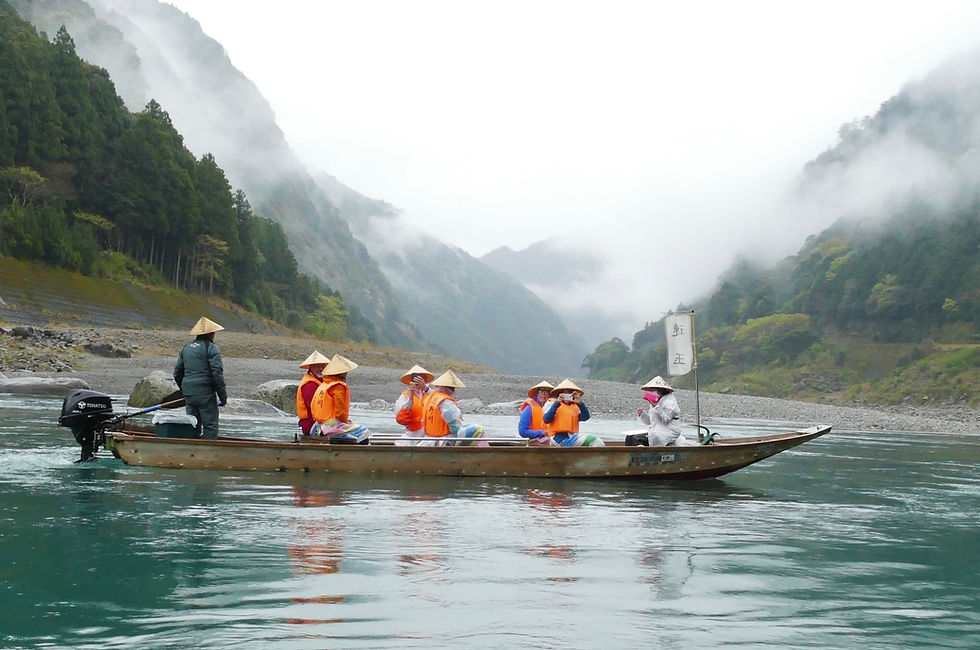
Riverboat ride to Shingu (bus alternative if unavailable).
Explore Kumano Hayatama Taisha and Kamikura Shrine with guide.
Visit Castle Ruins and/or Asuka-Jinja Shrine, or enjoy free time.
Total walking: 4–5 km, Easy.
Lunch at a local restaurant.
Local train to Kii-Katsuura.
Accommodation: Kii Katsuura traditional
Meals: B, L, D.

Day 3 — Hosshinmon Oji to Hongu & Yunomine
Bus or taxi to Hosshinmon Oji.
English-speaking Japanese guide joins for the day (groups of 12+).
Walk 7.5 km to Kumano Hongu Taisha.
-
Rated Easy to Moderate.
Explore shrines and surrounding architecture.
Lunch at Hongu.
Walk 3 km to Yunomine Onsen.
-
1 km flat, 1 km ascent (300 m), 1 km descent (200 m).
-
Rated Hard (bus option available).
Accommodation: Onsen inn at Kawayu Onsen.
Meals: B, L, D.

Day 6 — Nachisan & Departure
Early morning visit to Tuna Market (Mon–Fri only).
Bus to Nachisan.
Walk the famous Diamonzaka Slope.
Explore Kumano Nachi Taisha Shrine, Seiganto-ji Temple, and Nachi Falls (tallest in Japan).
Total walking: 4–5 km, Easy to Moderate.
Bus return to Kii-Katsuura for lunch and onward travel.
Train journey (3.5 hrs) along the Kii Peninsula to Osaka KIX Airport.
Arrive ~5:30 pm for flights from 7:30 pm onwards.
Meals: B
Note: Itinerary may change due to weather or group requests, with adjustments discussed at daily briefings.
Walking in Japan with Confidence and Care
Japan is known for its calm efficiency and considered approach to travel, particularly along established pilgrimage routes such as the Kumano Kodo. This fully guided journey is planned with that same sensibility — measured, flexible, and responsive to real conditions as they arise. Practical decisions are handled quietly in the background, allowing the experience itself to remain steady, grounded, and uninterrupted.
Why Walk the Kumano Kodo with Home Comforts Hiking
Walking the Kumano Kodo with Home Comforts Hiking is guided by a complete pilgrimage perspective rather than a purely hiking focus. Our fully guided journey intentionally visits all three sacred Kumano shrines, allowing the pilgrimage to unfold as it has traditionally been understood, with a clear beginning, progression, and completion. This approach honours the spiritual and cultural depth of the route while offering a quieter, more considered experience through small group travel and thoughtful pacing, where meaning is given as much space as movement.
When you choose to confirm your place on the fully guided Kumano Kodo, the journey begins well before you arrive in Japan. After booking, you will receive clear, staged guidance to help you prepare both practically and personally, including what to expect, how to get ready, and how the walk will unfold. Communication is thoughtful and unhurried, with regular updates and opportunities to ask questions as the pilgrimage approaches, so you feel informed, supported, and quietly confident every step of the way.
Frequently Asked Questions
What is included in the price?
Your guided tour includes accommodation on a twin-share basis, 5 breakfasts, 3 lunches, 5 dinners, daily luggage transfers on the trail, public bus fares used during the tour, a private taxi or bus on Day 3, an English-speaking guide for the full six days, and interpretive guiding on 2 to 3 shrine days for larger groups. You also receive route maps, trip notes, and practical safety information.
What is not included?
Airfares, train fares to Kii-Tanabe and from Kii-Katsuura, 2 lunches, drinks and snacks, personal incidentals, passport and visa if required, and travel insurance.
How much does it cost?
-
Tour, twin share: See relevant tour as pricing can vary.
-
Single supplement: See relevant tour as pricing can vary.
-
All prices are in Australian dollars AUD
How difficult is the hike?
Overall the guided itinerary is rated moderate, with some steep and hilly sections that can feel hard for inexperienced or less fit hikers. We walk about 50 km over five hiking days, typically 7 to 15 km per day. The average group pace is about 2.5 km per hour with regular breaks to enjoy views, villages, and shrines. If you want longer distances or the full Nakahechi, consider our self-guided tours.
What are the accommodation arrangements?
We stay in small village guesthouses where availability is limited. Rooms are twin share. Solo travellers are paired with the same gender; if pairing is not possible, a single room may be arranged with the single supplement. Bedding, linen, and towels are provided. Pillows in Japanese inns can be firm, so bring your own if you prefer. Many properties have onsite onsen baths, and some villages have excellent public onsens nearby. Most minshuku have shared bathing in gender-segregated onsen areas. Morning bathing is often unavailable, but wash basins are provided.
What Meals Are Included?
Breakfast (B) is included daily, usually Japanese style, sometimes with a Western option.
Dinner (D) is included on five nights, including a welcome dinner in Kii-Tanabe on the first night.
Lunch (L) is included on three trail days and again in Shingu; on the other days you can buy lunch at local shops or cafes.
Snacks and drinks are not included.
Dietary requests: We pass requests and allergies to our hosts. Vegetarian options are available in many places. Please note that katsuo dashi (fish broth) is common in Japanese cooking and can be difficult to avoid completely.
Is the water safe to drink?
Yes. Tap water in the Kumano area is high quality. Bring bottles or a hydration bladder and refill each morning.
How does luggage transfer work?
Luggage transfer is included on all guided hikes. Each guest can check one bag up to 20 kg. Leave your bag at reception by around 8:30 am and it will be delivered to the next inn. You carry only a daypack while walking.
Good to know: Only one checked bag per person is allowed for transfer. Even with transfer, you still need to move your own bag up and down stairs and to and from stations. Pack light. Most inns have washing machines and dryers.
What should I bring?
A small daypack with rain cover, one 20 kg bag for transfer, hiking clothing, sturdy shoes, rain jacket, hiking poles, swimsuit, toiletries and personal medication, money card, passport and visa if required, travel insurance documents, phone or camera with chargers. Yukata robes, shampoo, conditioner, and body wash are provided at the inns. If you prefer a soft pillow, bring your own.
When should I book?
Book any time up to one month before the tour start date. That said, our fully guided tours often book out quickly, so the sooner you book, the more likely you will be able to join the tour of your choice. Tour dates are usually posted to our website at least 12 months in advance.
How do I book and pay?
You can book online or contact us directly. A AUD 500 per person deposit secures your place.
The remaining payment is due one month before the tour date. This is how you can pay:
Australian customers can pay by bank transfer:
Home Comforts Hiking | BSB 923100 | Account 36237075
Overseas customers receive a PayPal invoice in AUD. You do not need a PayPal account and can pay by Visa or Mastercard. You may also pay in Australian Dollars via a transfer service such as Wise or through your bank:
Home Comforts Hiking | BSB 923100 | Account 36237075
The SWIFT Code for ING Bank Australia is INGBAU2S
Cancellations and Refunds
Please see our Cancellation and Refund Policy.
When should I book my flights?
-
Book flights after your trip is confirmed. If you are flying home the final day, aim for departures after 7:30 pm from Osaka Kansai International Airport. The train from Kii-Katsuura to KIX takes about 3.5 hours and typically arrives around 5:30 pm.
Where do we meet on Day 1 and where does the hike finish?
We meet at our hotel in Kii-Tanabe. Buy your JR train ticket to Kii-Tanabe (Wakayama Prefecture) at Osaka Kansai International Airport, then travel by limited express. Please arrive at the accommodation by 5:00 pm. Trip briefing is at 5:30 pm.
The hike finishes at Kii-Katsuura around 12:30 pm on Day 6. From there you can take the afternoon train to KIX or continue your Japan journey. We can help with tickets.
Group size and guides
Some departures are led by our local English-speaking Japanese guide, Yoko Murakami, who has more than ten years of Kumano Kodo experience.
-
Tours with Yoko have a maximum of 8 guests. If fewer than 8 guests are booked, a small-group surcharge may apply to cover guide costs.
-
Fully guided tours with 12 guests or more have a second guide.
If you prefer no guide or guiding on only some days, see our self-guided tours.
What pace do you set and what if I am slower?
Your guide sets a slow to moderate pace with frequent breaks for water, photos, and shrine visits. If you need extra support, your guide can adjust the plan, suggest a bus segment, or arrange a shorter route so the experience stays safe and enjoyable.
Do you offer a guarantee?
Yes. If we cannot confirm your chosen dates and accommodation, your deposit is fully refundable. We strongly recommend comprehensive travel insurance for cancellation cover, medical situations, and valuables.
Top tips for a smoother trip
Test your shoes before you travel. Pack light. Carry snacks and water each day. Use Google Translate for quick conversations. The Japan Transit app is excellent for transport info. ATMs are widely available at 7-Eleven and FamilyMart. Ponchos work well over a daypack in rain. Bamboo hiking poles can be bought or borrowed locally. There are no public rubbish bins on the trail, so carry out your rubbish and dispose of it at your inn each evening.
Need help right now?
We are here to help with planning, dates, and practical questions.
Reach out to our Guides directly.
Featured in ...